
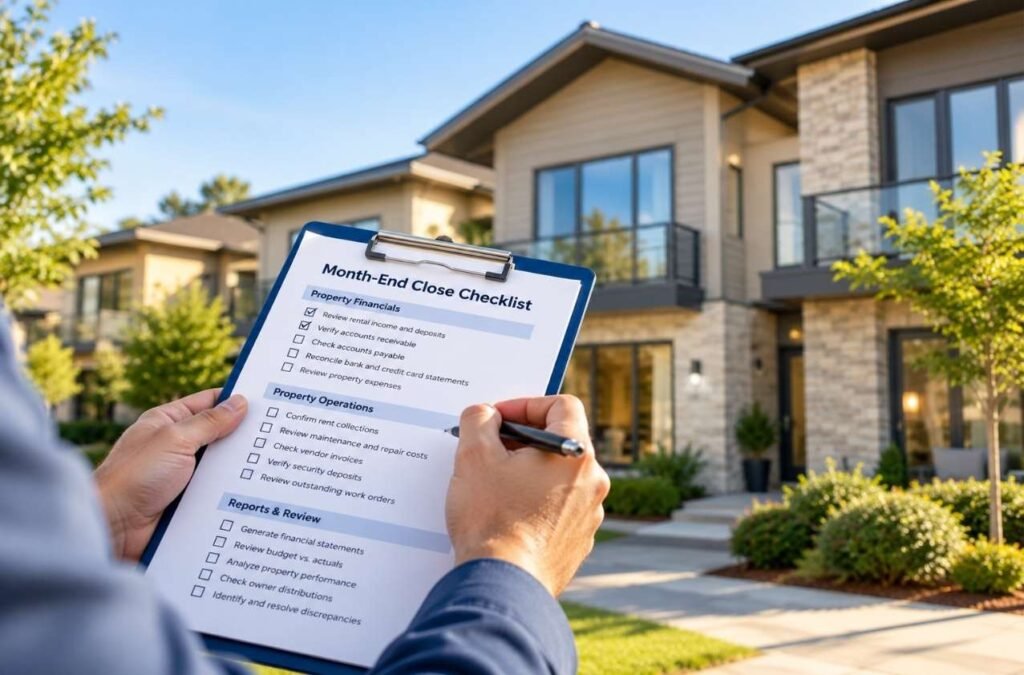
A property manager can reconcile the bank, post the rent, pay the bills, and still have a month that’s not ready to report. Missing invoices, unmatched tenant payments, misclassified property costs, or unexplained changes can affect the numbers owners rely on.
That’s why a real estate month-end close checklist needs to cover more than routine bookkeeping. Property managers need a repeatable way to confirm that each property’s activity is complete, properly recorded, and ready for review. Owners, meanwhile, need clear financial information they can understand without digging through individual transactions.
This guide walks through the month-end close process for U.S. property management businesses, from preparing records to reviewing financial statements and finalizing the period. Use it as a practical framework for building a property management monthly close checklist that helps your team catch issues before reports reach owners. This matters more when several properties share one workflow.
Key Takeaways
➤ A real estate month-end close helps property owners and managers confirm that income, expenses, balances, and supporting records are complete and ready for reporting for each reporting period.
➤ Start by setting the cutoff date, gathering property records, and checking for missing or unposted transactions before beginning the close.
➤ Reconcile rent, bank accounts, AR, AP, accruals, prepaids, repairs, capital costs, and property-level records to catch issues early.
➤ Review the P&L, balance sheet, cash position, and budget variances to understand property performance and explain unusual changes.
➤ Finalize the close by resolving exceptions, saving records, completing sign-offs, issuing owner reports, and locking the period.
What Is a Real Estate Month-End Close?
A real estate month-end close is the process of completing and reviewing accounting records for a defined reporting period. For a property management business, it brings property income, expenses, balances, and supporting records together before monthly reports are treated as final each month.
The close should answer one question: Can the financial information for this month be relied on? The process must follow the accounting method the business uses consistently, whether handled internally or through real estate accounting services.
For managers overseeing several rental properties, the work needs a property-level view. A portfolio can look reasonable overall while one property has a missing invoice, unusual expense, or balance needing attention. This makes a property management bank reconciliation useful for keeping property-level checks visible.
The close is also different from preparing a tax return. Monthly records are used to understand property performance and support reporting, while tax reporting follows applicable tax rules and accounting methods. Keeping those purposes separate helps prevent tax questions from disrupting the monthly reporting workflow.
What Should You Prepare Before Starting the Property Accounting Month-End Close?
A clean close starts with a clear reporting period and complete source information. This gives the accounting team a defined starting point and creates a practical foundation for a property management monthly close checklist.
1. Set the month-end cutoff date
Define the last date included in the reporting period and how transactions received after cutoff will be handled. A written rule helps prevent late items from being treated differently from month to month and gives the month-end close checklist for property managers a clear starting point.
2. Gather records for every property
Collect the records needed to support the month’s activity, such as:
(i) Bank and credit-card statements
(ii) Rent and tenant records
(iii) Vendor invoices and bills
(iv) Owner contributions and distributions
(v) Loan and escrow information
(vi) Capital expenditure documentation
For U.S. businesses, supporting records should be kept in an orderly way because they substantiate entries in the books and items reported on tax returns. The IRS lists invoices, paid bills, receipts, deposit slips, and canceled checks among common supporting documents. These records also support property management accounting services when accounting work is handled by an outside team.
If your portfolio includes vacation or short-term rentals, a short-term rental accounting guide can also help you understand which property records and financial details need to be maintained throughout the year.
3. Check for missing or unposted transactions
Look for unposted rent, unapplied payments, missing vendor bills, pending refunds, recurring charges, and transactions sitting in suspense. Resolve missing source documents before treating the period as complete. This step should remain part of the property management month-end closing process rather than being left until owner reports are ready.
Real Estate Accounting Month-End Checklist: 7 Steps to Follow
The order of a property management monthly close matters because each review depends on information being complete and accurate. Work through the core accounting checks first, then review property performance and finalize the records for reporting.
1. Confirm rental income and property transactions
Compare rent charges and collections with the rent roll and accounting records. Check move-ins, move-outs, prorated charges, late fees, and other property income for the period. These checks should be part of any month-end accounting checklist for property management because rental activity directly affects the month’s reported results.
Also check unapplied or misapplied tenant payments. A payment in the wrong account can make both the tenant balance and property income look wrong. The month-end close checklist for property managers should make this review a defined task rather than an informal check.
For example, if a property collected $20,000 in rent but the ledger shows a different amount, the team should identify whether the difference comes from timing, an unapplied payment, a posting error, or another valid transaction. Explain the difference before it reaches the owner report. A detailed rent roll review can help identify these differences before reporting.
2. Reconcile bank, credit card, reserve, and trust accounts
Reconcile each relevant account to its accounting balance. Review outstanding checks, deposits in transit, bank fees, interest, and other differences that need to be recorded or explained. A property management monthly close checklist can help make sure these account reviews are completed for every applicable property and account.
If the business maintains reserve or trust accounts, include them where applicable. Security deposits, for example, should not be casually treated as operating income. The related records should agree with the accounting treatment used by the business. This is an important control within the security deposit reconciliation process.
The key question is whether every material difference has a clear explanation and next step. That makes month-end reconciliation for property management more useful than simply checking whether an account has been marked reconciled.
3. Review accounts receivable and accounts payable
Review the AR aging for overdue balances, unusual credits, unapplied cash, or amounts needing follow-up. An accounts receivable month-end review helps the team identify balances that need attention before monthly reporting is completed.
Then review AP. Confirm invoices received before cutoff are recorded, assigned to the correct property, and posted to the correct period under the business’s accounting method. Look for duplicate bills and large unpaid balances that may affect cash planning. These checks belong in an accounts payable month-end review because both receivables and payables can affect the accuracy of property-level reporting.
When several properties share vendors, also check that invoices are charged to the property that received the work. A correct company-wide expense total can still produce inaccurate property-level results if the coding is wrong. Your month-end accounting checklist for property management should, therefore, include property-level invoice coding.
4. Record accruals, prepaids, and other adjusting entries
Record appropriate adjustments needed to present the period consistently. Depending on the accounting method and reporting needs, these may include accrued utilities, property taxes, insurance, maintenance, management fees, or other recurring costs. A real estate monthly accounting checklist can help keep these entries visible during the close.
Review prepaid items too. An insurance payment covering future periods, for example, may need to be handled over the periods to which it relates under applicable accounting and tax rules.
5. Review repairs, capital expenditures, and fixed assets
Large property costs deserve a closer look before the P&L is finalized. Determine whether an item is an ordinary repair or may need capitalization under applicable accounting and tax rules. This review is a useful part of property management month-end accounting because large property costs can affect both current-period results and future records.
For U.S. rental property, IRS guidance generally distinguishes deductible repairs from improvements that must be capitalized, subject to applicable rules and elections. Improvements can include work that betters, restores, or adapts property.
Review significant project invoices and property assignments. If a major renovation was recorded as a routine repair without review, the classification may need correction. Keep records needed to establish the property’s asset cost and later depreciation treatment. A property expense review can help ensure these larger transactions receive a separate review.
6. Tie property-level records to the general ledger
Compare property-level records with the general ledger. Review whether rental income, operating expenses, management fees, owner activity, and other balances are assigned to the right property and entity. This is a core part of the property management month-end closing process.
This matters when one accounting system contains many properties. A portfolio can appear reasonable even when one property’s costs have been posted to another. Clear property records can also make short-term rental accounting services easier to manage when multiple units or properties are involved.
7. Review and finalize the general ledger
Before reviewing financial reports, scan the ledger for unusual balances, suspense accounts, unexpected negative balances, and material journal entries. Confirm that key reconciliations and adjustments are complete.
What Financial Reports Should Property Managers Review at Month End?
A completed reconciliation does not automatically mean the financial results make sense. After accounting entries are complete, managers should review the main reports for unusual movements, missing information, and changes that need explanation before reports are issued.
1. Review the Profit and Loss statement
Look at rental income, operating costs, and net operating results for each property. Focus on changes that need a business explanation. This forms an important part of the property management financial statements review.
If maintenance expense rises sharply at one building, for example, the manager should be able to connect the change to work performed, invoices, or a known property event. Knowing how real estate accounting works can also help property managers understand how these income and expense entries flow into the financial results they review each month.
2. Review the balance sheet
Review cash, receivables, payables, loans, security-deposit liabilities, owner balances, and material accounts. For example, a rent roll reconciliation can help confirm that tenant-related balances are properly reflected in the accounting records. A balance sheet review can reveal issues that don’t appear clearly on the P&L.
The review should also consider whether balances support the information shown in the property management monthly financial reports. A mismatch can point to an item that needs further investigation.
3. Review cash flow and cash position
Compare the reported cash position with major cash movements during the month. Consider owner distributions, debt payments, capital projects, transfers, and other significant uses or sources of cash. This helps separate an accounting result from the cash actually available for property or owner needs.
It also gives owners more context when they complete an owner statement review. For example, a rental income reconciliation can help explain whether reported rental receipts align with the cash activity being reviewed.
4. Review budget vs. Actual variances
Where a budget is maintained, compare actual results with expectations. Focus on material differences in rental income, maintenance, utilities, management fees, and other major categories. This budget vs. actual property management review can show where results need further explanation.
The review should also consider whether the reports tell a consistent story. If profit rises while cash falls, for example, the manager should identify the transactions or timing differences behind that result.
What Should Property Owners Review Each Month Before Receiving Reports?
Property owners do not need to repeat the accounting team’s work, but they should understand the results before relying on them. A focused owner review can highlight cash changes, unusual expenses, property performance, and unresolved items.
1. Check property income and expenses
Review whether rental income and major expenses look reasonable for the property. If one property’s results change sharply from the prior month, ask what operational event caused the change. Clear records also make it easier to read a Profit and Loss statement.
2. Review cash, distributions, and reserves
Look at cash available for the property, owner distributions, and reserve balances. Large repairs, planned projects, debt payments, or other commitments may explain why cash changed even when operating results appear stable.
3. Ask about unusual variances
Ask for an explanation of material changes rather than assuming they are errors. A large repair may be valid, while a lower rent figure may reflect a vacancy. Significant changes should have a clear business reason.
How Should Property Managers Finalize the Month-End Close?
Once the accounting and reporting reviews are complete, the final stage is to turn the reviewed records into a controlled reporting package. This is where the team closes open questions and creates a clear record of what was finalized.
1. Resolve material exceptions or document why they remain open.
2. Save supporting records with the appropriate accounting files.
3. Complete the required review or sign-off.
4. Finalize owner reports.
5. Record the close status and date.
6. Lock the period according to the business’s established process.
7. Use a controlled correction process for material changes made after close.
The final package should make it clear which period was reviewed, which reports were issued, and which exceptions, if any, remain open. That record gives the next reporting cycle a clean starting point and reduces uncertainty about whether a number was intentionally carried forward.
What Are Common Month-End Close Mistakes in Property Management?
A month-end close can look complete while still containing problems that affect property reports. The most useful review is not only whether a task was completed, but whether the resulting balance is supported, explained, and assigned correctly.
1. Closing before all relevant transactions are recorded
2. Accepting unexplained reconciliation differences
3. Missing vendor invoices received before cutoff
4. Leaving tenant payments unapplied or misapplied
5. Posting costs to the wrong property
6. Treating a potentially capital improvement as a routine repair without review
7. Ignoring differences in security-deposit records
8. Sending owner reports without investigating material variances
9. Leaving significant exceptions undocumented
10. Making changes to a finalized period without a controlled correction process
How Can Property Managers Make the Month-End Close More Reliable?
A reliable close depends less on adding tasks and more on making the existing process consistent. Clear ownership, repeatable timing, and exception tracking can make the workflow easier to manage as the portfolio grows.
1. Assign clear ownership: Identify who prepares each reconciliation, who reviews it, and who follows up on exceptions. A task without an owner can remain open when everyone assumes someone else is handling it.
2. Use the same close order every month: Keep the sequence consistent so the team knows which information must be ready before the next review begins. This also makes it easier to spot a skipped step.
3. Track exceptions separately: Maintain a simple list of unresolved items, their impact, the person responsible, and the planned resolution. This prevents open issues from disappearing inside a completed checklist. A general ledger review can also help determine whether unresolved items have affected the accounts.
4. Review trends, not just individual transactions: Use prior-period and budget comparisons to identify changes that deserve attention. A real estate accounting month-end checklist can support the review, while multi-family / single-family accounting services can help maintain consistent property-level reporting as the portfolio grows.
Make Your Property Month-End Close More Accurate With VRSapients!
A reliable property management month-end close gives owners and managers more than a completed set of accounting tasks. It creates a clear point where the records have been checked, important differences have been investigated, and the financial reports are ready to support the next business conversation. A well-managed property management monthly accounting checklist can make that process easier to repeat.
Use the checklist as a repeatable monthly process, but adjust the details to your properties, accounting method, reporting needs, and internal controls. The goal isn’t to make every close identical. It’s to make the important reviews consistent and make exceptions visible before they affect decisions.
If your current process depends on last-minute reconciliations or manual follow-ups, start by documenting the close order, assigning ownership, and tracking open items. VRSapients can help you build a dependable property accounting workflow and keep monthly reporting organized.
Write to us here, schedule an appointment, or call (+1) 315-961-2217 to discuss your property accounting and month-end close needs.
Frequently Asked Questions
What are some important checklists for property management?
What are some important checklists for property management?
Important property management checklists can cover tenant move-ins and move-outs, property inspections, maintenance, rent collection, vendor payments, and monthly accounting.
For your accounting workflow, a property management monthly close checklist should also cover reconciliations, AR and AP, property-level records, financial statements, and owner reporting.
How does the IRS treat rental income?
How does the IRS treat rental income?
For U.S. federal tax purposes, rental income generally includes payments you receive for the use or occupancy of your property. If you use the cash method, you generally report income when you receive it. Advance rent is generally taxable when received, while refundable security deposits generally aren’t income when received.
What should a rent roll include?
What should a rent roll include?
A rent roll should give you a clear view of each property’s rental activity. It commonly includes the property and unit, tenant name, lease dates, monthly rent, security deposit, payment status, balance due, and lease status. You can also include concessions, fees, vacancy details, and other useful lease information.
How are security deposits treated in accounting?
How are security deposits treated in accounting?
If you’re holding a refundable security deposit, you generally shouldn’t treat it as rental income when you receive it. Keep it separate from rent in your records and track the amount owed to each tenant. If you later keep part of it under the lease terms, the tax treatment can change. State trust-account rules may also apply.
What information should be included in a property management owner ledger?
What information should be included in a property management owner ledger?
Your owner ledger should make it easy to see how money moved for each property. Include the opening balance, rental income, other income, property expenses, management fees, owner contributions, distributions, reserves, and ending balance. You should also be able to trace unusual amounts back to supporting transactions or records.