When someone else helps with your rental bookkeeping, differences in how transactions are recorded can create confusion. One person may use a broad category, while another creates a new one for a similar cost. Over time, reports become harder to compare, and questions take longer to resolve.
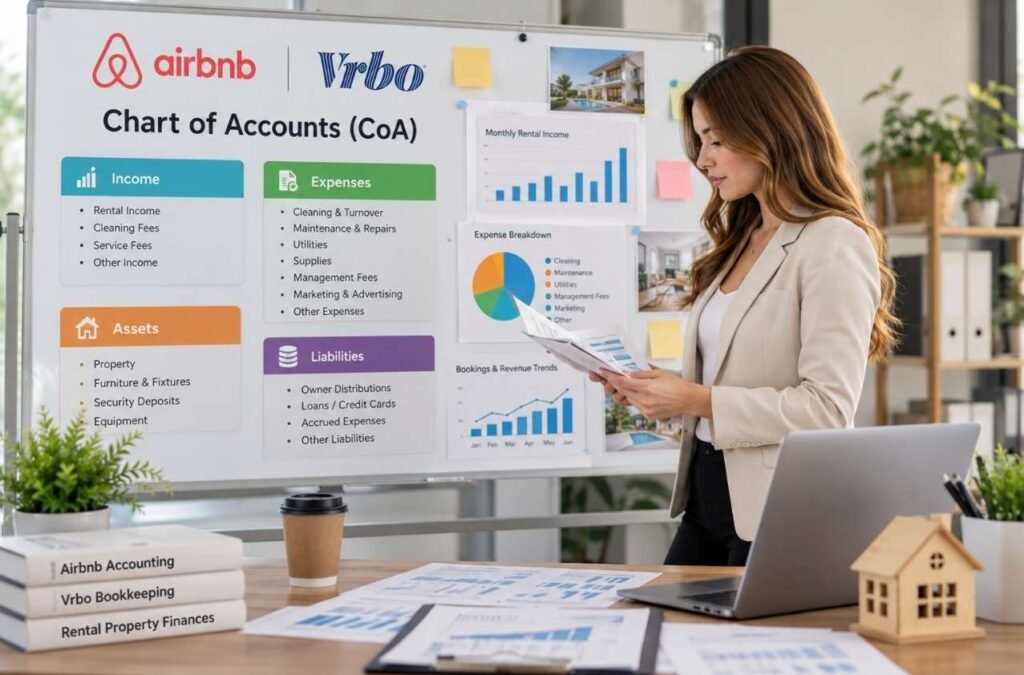
A vacation rental Chart of Accounts (CoA) gives the owner and bookkeeper a common structure to follow. Clear account names and consistent rules reduce guesswork and make it easier to explain why a transaction was recorded in a certain way.
For Airbnb and Vrbo hosts, this structure is especially useful when bookkeeping is shared with a professional or handed over at tax time. The aim isn’t to make the records look technical. It’s to make them understandable to anyone who needs to review them. A rental property Chart of Accounts (CoA) setup can help the working relationship run more smoothly and give you confidence in the information you receive.
Key Takeaways
➤ A short-term rental Chart of Accounts (CoA) helps Airbnb and Vrbo hosts organize booking income, operating costs, assets, liabilities, and owner transactions.
➤ Create clear income accounts for nightly charges, cleaning fees, guest fees, refunds, and booking adjustments. Track expenses by purpose without creating unnecessary categories.
➤ Record gross booking charges and platform fees separately so payouts match bank deposits and reports.
➤ Track each property’s income and expenses using property codes or tracking fields. Classify deposits, mortgage payments, repairs, and improvements correctly.
➤ Review your CoA monthly, reconcile platform reports and bank balances, check uncategorized transactions, and update accounts as your rental business grows.
What Is a Short-Term Rental Chart of Accounts (CoA)?
A Chart of Accounts (CoA) is the list of categories your accounting system uses to organize financial transactions. For a vacation rental business, it provides a consistent way to classify booking receipts, operating costs, property assets, outstanding debts, and owner activity. These short-term rental accounting categories help make financial records easier to understand and review.
A clear structure also helps short-term rental accounting services maintain consistent records across bookings, expenses, and property-related transactions.
How a Chart of Accounts (CoA) works for Airbnb and Vrbo rentals
Suppose you pay a cleaner after a guest checks out. Your bank statement shows the payment, but the CoA tells your bookkeeper where to classify it. Recording it under cleaning expenses helps you see how much you spend preparing the property for each stay.
Each account has a name and may have an account number. The number helps organize the list, while the name explains the account’s purpose. Your accounting system then uses these categories to prepare reports. With a clear Chart of Accounts for Airbnb and Vrbo, hosts can understand how to categorize Airbnb income and expenses.
The five main account groups in a rental business
Account group | What it records | Rental example |
Assets | What the business owns or controls | Bank cash, furniture, property |
Liabilities | What the business owes | Mortgage balance, refundable deposits |
Equity | The owner’s interest in the business | Owner contributions and distributions |
Income | Money earned from rental activity | Nightly charges and guest fees |
Expenses | Costs of running the rental | Cleaning, insurance, repairs |
These groups serve different purposes. Income and expenses help explain operating performance. Assets, liabilities, and equity show the business’s financial position.
Keeping them distinct helps prevent a loan payment, owner withdrawal, or refundable deposit from being treated as ordinary operating income or expense. These Vrbo and Airbnb income and expense categories should reflect the underlying transactions.
What Accounts Should an Airbnb or Vacation Rental Business Have?
The right vacation rental Chart of Accounts (CoA) reflects your actual operations without making every small purchase a separate category. Start with the accounts you need to record regular activity, then add detail when it improves reporting or helps answer a clear business question. This is a practical starting point when deciding what accounts should an Airbnb host have for accurate bookkeeping.
1. Income accounts for short-term rentals
Consider these accounts for rental revenue:
(i) Nightly rental income: Charges for the accommodation itself.
(ii) Cleaning fee income: Cleaning charges billed to guests, when tracked separately.
(iii) Other guest fees: Additional charges earned under your booking terms.
(iv) Booking adjustments and refunds: A suitable account or adjustment method for cancellations, refunds, and corrections.
Separate cleaning income from cleaning costs if you want to understand both amounts. A guest charge doesn’t automatically equal the amount paid to the cleaner. If a platform collects or remits certain amounts on your behalf, follow its transaction reports and your accounting method when recording them.
A well-organised Vrbo and Airbnb Chart of Accounts (CoA) keeps nightly charges, cleaning fees, and booking adjustments identifiable.
2. Expense accounts for Airbnb and Vrbo hosts
Group expenses by their business purpose. A useful starting list includes:
(i) Platform and payment processing fees
(ii) Cleaning and laundry
(iii) Guest supplies and amenities
(iv) Repairs and routine maintenance
(v) Utilities, internet, and communications
(vi) Insurance and property taxes
(vii) Property management and professional fees
(viii) Mortgage interest
(ix) Depreciation, where applicable
These short-term rental expense categories help hosts organise common operating costs. Avoid creating a new account for every supplier. For example, payments to different cleaning contractors can usually share a cleaning expense account. Supplier names belong in the transaction details or vendor records.
If managing these records becomes time-consuming, you can also hire a bookkeeper to keep your rental finances organised and accurate.
3. Asset, liability, and equity accounts
Your Chart of Accounts for Airbnb and Vrbo should also cover balances that aren’t ordinary income or operating costs.
Account type | Sample accounts | Purpose |
Assets | Business bank account, furniture, building | Tracks cash and property resources |
Liabilities | Mortgage payable, accounts payable, refundable deposits | Tracks debts and amounts owed |
Equity | Owner contributions, owner distributions | Tracks owner funding and withdrawals |
You may also need accumulated depreciation and lodging tax payable accounts. The right structure depends on your business and the funds you handle. Not every host needs every account listed here. A rental property Chart of Accounts (CoA) can be adjusted as the rental business develops.
For U.S. owners, the IRS uses Schedule E for many rental real estate activities, but some activities may require different reporting. Your book categories should support the correct tax treatment rather than force every transaction into a tax line.
How Should You Classify Common Short-Term Rental Transactions?
Account names alone won’t resolve every bookkeeping question. The key is to identify what each transaction represents before recording it. Your booking records, platform statements, invoices, and bank activity should work together to support the classification.
1. Record gross booking activity and platform fees separately
A platform payout may be lower than the amount charged for a reservation because of fees, adjustments, or other deductions. Recording only the bank deposit can hide these details. Hosts need to understand how to track Airbnb fees in bookkeeping and keep gross booking charges separate from platform deductions.
Consider this hypothetical booking:
Transaction | Amount |
Nightly charges | $600 |
Cleaning fee charged to guest | $80 |
Gross booking charges | $680 |
Platform fee | −$20 |
Net payout | $660 |
For this simplified example, assume no taxes, refunds, or other adjustments. Record the booking charges and platform fee separately, then reconcile the $660 payout against the bank statement. The exact entries depend on the platform report and your accounting method. A clear Chart of Accounts for Airbnb and Vrbo helps keep income and fees identifiable.
Airbnb explains that Form 1099-K reports gross payment transactions before its fees are deducted. Hosts can use their earnings reports to help reconcile these amounts.
2. Classify cleaning fees, refunds, deposits, and lodging taxes
Cleaning charges and cleaning bills represent different sides of the transaction. Record them separately if you want to compare guest charges with the cost of preparing each property. This distinction supports vacation rental bookkeeping categories used in financial reports.
Refundable deposits need separate attention. Under U.S. IRS guidance, a security deposit intended for return generally isn’t rental income when received. If you keep an amount as rent, its tax treatment changes.
Taxes collected for payment to a government authority may need a liability account when you remain responsible for sending them onward. If a platform collects and remits a tax, check its report to see how that amount was handled. Don’t record every tax-related payment as revenue or expense without checking the facts.
3. Separate repairs, improvements, and loan payments
Routine repairs help keep a property in working order. Improvements may add value, restore a major part, or adapt the property to a new use. The IRS treats qualifying improvements differently from ordinary repairs, so don’t assume every contractor invoice is a current expense. These distinctions affect Vrbo and Airbnb expense categories used to record operating costs.
Mortgage payments also need to be split. Principal reduces the outstanding loan balance, while interest is a financing cost. Recording the full payment as an expense can overstate operating costs and leave the loan balance wrong.
※ If you’re unsure how to classify booking revenue, separate platform fees, or record repairs and loan payments correctly, our short-term rental accounting guide explains the key bookkeeping practices for rental businesses.
How Should You Organize Accounts Across Multiple Rental Properties?
Once you manage more than one rental, the account structure needs to support both shared reporting and property-level comparisons. The aim is to make it easy to review the portfolio as a whole while still seeing which property generated each transaction. A Chart of Accounts for vacation rentals can help hosts decide how to track expenses for multiple rental properties.
1. Use property-level tracking instead of duplicating every account
You usually don’t need separate cleaning, insurance, or repair accounts for every listing. Instead, use a shared account structure and add a property name, code, or tracking field to each transaction.
For example, a cleaning bill for Lake House A and another for City Apartment B can both use the same cleaning expense account. The property tracking field keeps their costs separate in reports. When managing several listings, a Vrbo and Airbnb Chart of Accounts (CoA) paired with property-level tracking helps you compare expenses without creating duplicate accounts for each property.
This approach helps you compare similar costs across properties. It also keeps the CoA manageable as you add listings. Use separate accounts only when the distinction helps with reporting, control, or a real accounting need.
2. Use separate accounts or entities
Separate bank accounts may help when properties belong to different legal entities, have different owners, or need distinct cash controls. The right setup depends on ownership, financing, agreements, and reporting needs. Ask your accountant before changing the structure.
Property managers who handle money for owners face another issue. Funds held for owners may need to be kept separate from the manager’s own operating cash, with clear records of what is owed to each owner. The manager’s income is not automatically the full amount collected from guests, making accurate records essential for property management accounting services.
For these cases, confirm the trust-accounting and legal requirements that apply to the business and location. A CoA supports the process, but it doesn’t replace the controls or records that the arrangement requires.
How to Set Up and Review Your Short-Term Rental CoA?
A good setup starts with the way your rental business actually operates. Before adding accounts, review the transactions you handle, the reports you need, and the details your tax professional will ask for. Then test the structure against real activity.
1. Build the structure around your business
Start with a list of properties, business entities, income types, regular expenses, assets, and liabilities. Use the sample CoA above as a guide, not a fixed template. Add accounts only when they provide a clear purpose.
If your accounting system supports account numbers, use a consistent numbering pattern. Keep names short and clear, and write down how unusual transactions should be classified. This helps you and anyone assisting with the books follow the same approach.
2. Test the accounts with real transactions
Before relying on the structure, test a few common transactions:
(i) A booking with a platform fee and net payout
(ii) A cleaner’s invoice
(iii) A guest refund
(iv) A refundable deposit
(v) A repair bill
(vi) A mortgage payment
Testing a Vrbo and Airbnb Chart of Accounts (CoA) against actual bookings, refunds, supplier invoices, and loan payments helps reveal classification gaps before they affect financial reports.
Check whether each transaction has a clear account and property label. Confirm that transfers between bank accounts aren’t being recorded as income or expenses. If an item doesn’t fit, revise the structure or document the correct treatment before similar transactions build up.
3. Review the structure regularly
During your monthly review, look for uncategorized transactions, duplicate accounts, unusual balances, and costs recorded under the wrong property. Check that platform reports agree with recorded booking activity and that bank balances reconcile.
Keep earnings reports, invoices, receipts, loan statements, and tax records with the related transactions. The IRS advises rental owners to retain records that support reported income and expenses.
A short monthly review can also reveal when your CoA needs an update, such as when you add a new service, property, or business entity. Update your rental property Chart of Accounts (CoA) when the business’s reporting requirements change.
※ If you want to keep track of bookings, expenses, and payouts without missing important details, use our short-term rental bookkeeping checklist to simplify your monthly reviews.
How a Clear CoA Supports Financial Reporting
Once transactions are classified consistently, your accounting system can prepare useful financial reports. The Profit and Loss statement groups income and expenses to show operating results. The balance sheet shows assets, liabilities, and equity at a point in time, providing essential information for real estate accounting services.
Consistent Vrbo and Airbnb bookkeeping categories make these reports easier to review and compare.
Property tracking adds another layer of insight. You can:
(i) Compare income and costs across rental properties.
(ii) Investigate differences before making pricing or spending decisions.
(iii) Review unusual balances and keep supporting documents available.
The value of these reports depends on the quality of your records. For U.S. owners, organized records can support tax preparation, including Schedule E when applicable. However, the CoA doesn’t determine which expenses are deductible or which tax form applies to every rental activity.
Take Control of Your Rental Accounts With VRSapients!
A well-structured vacation rental Chart of Accounts (CoA) gives you a clearer view of your rental income, operating costs, outstanding payments, and property-level results. It helps you understand where your money goes and gives you better records for financial reviews and tax preparation.
The key is to build an account structure that fits your business and keep it accurate as your portfolio grows. If you’re managing multiple Airbnb or Vrbo listings, handling platform payouts, or preparing records for tax time, the right accounting support can make the process easier.
VRSapients provides short-term rental bookkeeping and accounting services, including payout reconciliation, expense tracking, and property-level financial reporting. Our team can help you organize your accounts, maintain accurate records, and gain clearer insights into each property’s financial performance.
Start by reviewing your current Chart of Accounts (CoA) and identifying areas that need improvement. Write to us here, schedule an appointment, or call (+1) 315-961-2217 to discuss your short-term rental accounting needs and build a more reliable system for managing your rental finances.
Frequently Asked Questions
What expenses can I write off for my Airbnb?
What expenses can I write off for my Airbnb?
You may be able to deduct ordinary rental expenses, such as cleaning, repairs, utilities, insurance, property taxes, mortgage interest, management fees, and platform commissions. If you use the property personally, you may need to split expenses. Major improvements may need to be depreciated instead of deducted immediately.
Do I report Airbnb income on Schedule C or E?
Do I report Airbnb income on Schedule C or E?
For U.S. taxes, rental real estate income generally goes on Schedule E. However, if you provide substantial guest services, such as regular maid service during stays, Schedule C may apply. Your services and rental setup determine the correct form, so check with a tax professional before filing.
How to list on both Airbnb and Vrbo?
How to list on both Airbnb and Vrbo?
You can create a separate listing for the same property on Airbnb and Vrbo. Use matching property details, photos, amenities, and house rules. Then sync both calendars to help prevent double bookings. Check calendar updates regularly because changes may not appear instantly on both platforms.
Can you combine Vrbo and Airbnb?
Can you combine Vrbo and Airbnb?
You can manage bookings from both platforms for the same property, but their accounts remain separate. Sync your calendars to track availability and prevent overlapping reservations. You can also organize income, fees, and expenses from both platforms in one bookkeeping system while keeping each platform’s transactions identifiable.
Will Vrbo send me a 1099?
Will Vrbo send me a 1099?
Vrbo may send you Form 1099-K if your payments meet the applicable federal or state reporting rules. The form reports gross payment transactions before fees and refunds. Even if you don’t receive one, you may still need to report your taxable rental income.
How does Vrbo refund a damage deposit?
How does Vrbo refund a damage deposit?
Vrbo’s refundable damage deposit is returned to the guest unless you claim damage under its rules. If damage occurs, you may deduct reasonable repair costs when you document and report the damage within the required time. Any remaining deposit is refunded to the guest.